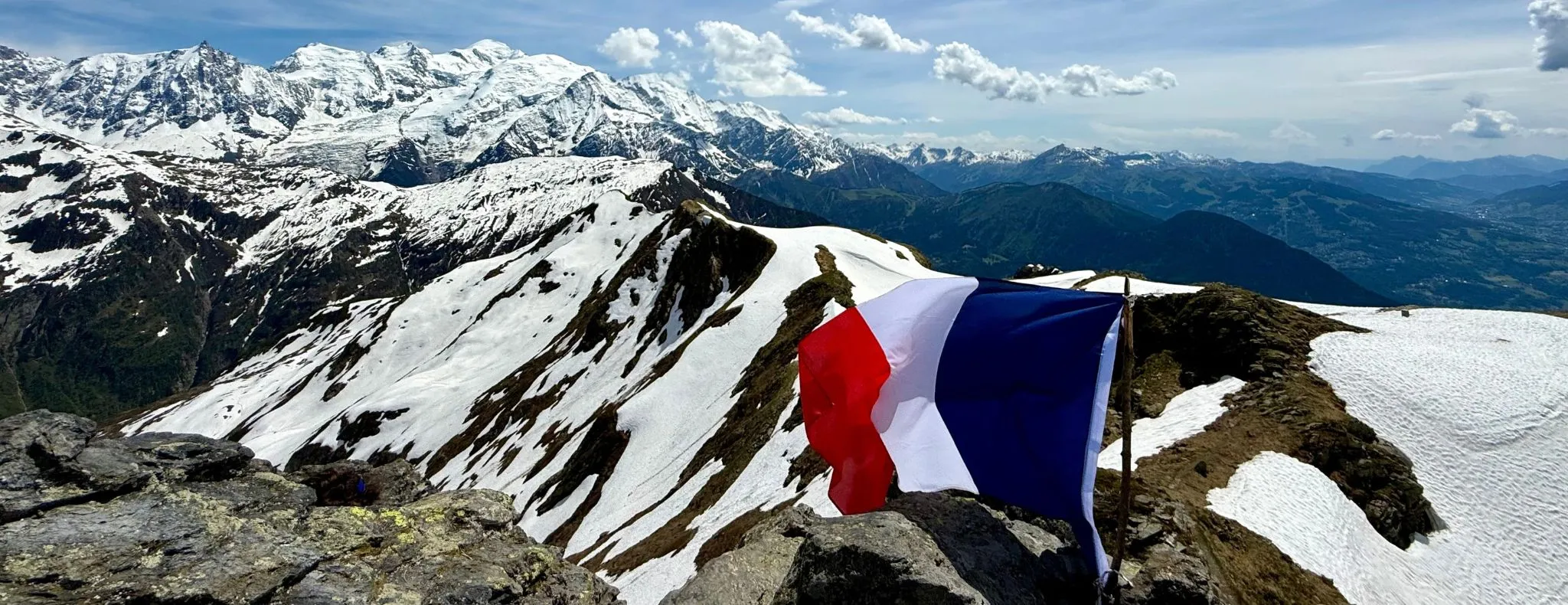
France is fabuleuse. She’s also feminine by the way, as in La France, which sadly is only because her name ends in the letter e. We like to think it’s because she has multi-layered beauty. She’s a multi-tasker balancing cultural heritage alongside natural wonders in almost one breath and, of course, she’s passionate. France’s natural resources are prodigious, her ability to inspire people around her is precious and her elegance is infectious. As adventurers, we love her, we discover more and more about her on a regular basis, she keeps us guessing yet constantly impressing. Read our best travel tips for France and find out how to live up to her finest expression: Vive la France!
Top things to know before travelling to France’s GR routes
Movies and TV shows such as Emily in Paris, Amelie or Chocolat have seduced many into a French frenzy, but they don’t exactly have the GR factor. If you don’t know about them already, France’s network of Grandes Randonnées (GR) long-distance trails are hiking icons. So much so that they quickly spread across Europe, but they were invented by a French man in the late 1940s. One of the most famous is the GR20 in Corsica, but their red and white signs pop up all over the country. For more details see our blog, France’s GR routes.

Advice for travelling to France’s national parks
The French may get teased about their unwieldy bureaucracy, but there are also times when it works perfectly. And managing their protected spaces is one of those. Because France has an extensive network of protected landscapes, with 59 Natural Regional Parks and 11 National Parks. And when you get an idea of the lay of their landscapes, you start to realise just how vast and varied France actually is. Read more about their green gems and how to access them on our hiking and cycling holidays in our blog, Top national parks in France.

Dos and don’ts in France on the Tour du Mont Blanc
The Tour du Mont Blanc is France’s most famous long-distance trail, known as the TMB for short. The first don’t is to think that it allows you to conquer the great peak. It doesn’t. It circumnavigates Mont Blanc instead meaning that, although the majority of walking holidays start and end in France, it’s actually a multinational massif, inviting you into Switzerland and Italy en route. If you’re going to take on the whole thing, you do need to get fit, you do need to book early, and you do need to be mountain safety savvy. You don’t have to stay in mountain huts the whole way, nor do you have to carry your bags and you don’t have to be a young thing. Our TMB folk range from 18 to 80. We do recommend, however, that you look at all your options in our blog, Everything you need to know about the Tour du Mont Blanc hike.

Best travel tips for France’s great markets
A hiking and cycling holiday in France is never complete without a trip to a local market. Many haven’t changed in centuries, with slow food just part of the French way of life. It’s hard to choose our favourites, but Provence’s are as pretty as they come, the Dordogne is cheese and charcuterie central and Bordeaux’s Marché des Capucins is a class act. For more guidance to the gourmet grand halls, and how to add them on to your adventures, see our blog, Best markets in France.
Explore France’s own camino
Although one of the Camino de Santiago routes, the Camino Frances starts in France, the majority of it takes place in Spain. Less well known, but still as impressive in terms of natural, cultural and spiritual heritage, is France’s Chemin du Puy or Camino le Puy, also known as the Via Podiensis. This is one of four ancient routes through France that historically joined up with the Camino de Santiago. However, it’s now a complete camino in its own right. Covering an epic 750km, between Le Puy-en-Velay in the Haute Loire and Saint-Jean-Pied-de-Port in the Pyrenees-Atlantiques, just 8km from the border with Spain, you can walk the whole thing in 40 days. This is a trek through the Auvergne, the volcanic landscapes of the Velay, the wild moorlands of Aubrac plateau, the Lot Valley and to great Pyrenean panoramas. Most people choose to walk it in sections, such as between Lectoure to Aire-sur-l’Adour through the vineyard-filled Armagnac region, or the last section Aire-sur-l’Adour to Saint-Jean-Pied-de-Port, with views of the snow-capped Pyrenees. Each section is also fully accessible by rail, giving it a truly eco blessing.

The positive side of France’s frostiness
Enjoy the frosty side of France on our snowshoeing holidays, which are a pure tonic for those who love to hike rather than hibernate in winter. They are also at the other end of the snowy spectrum to downhill skiing and are all about going slow in the snow. We have two snowshoeing holidays, both in Chamonix Valley and both between December and April. This is when the powder is promising and ready to propel you forward on trails around Saint-Gervais-les-Bains, where you are based throughout. The difference between the two holidays is that one is self-guided and the other privately-guided by a local mountain expert. Whichever you choose, you can expect snowfall between 25-54cm per week, and lowest temperatures averaging -6C, usually in January.

What not to do as a tourist in France
Generalising a bit here, but for the most part, the French are pretty traditional. It’s not the case for everyone of course, and the last few decades have seen the French even challenge their own stereotypes. Don’t expect people to go out of their way to speak English. The French are a proud people and have a reputation for believing that their country is hard to beat. Which, it really is quite hard to do in fairness to the French. It has steep competition, that’s for sure, but honestly, France is a force to be reckoned with when it comes to patriotic pride and cultural self-preservation.
Blowing hot and cold
If you tell the French that they’re the best at just about everything, they’ll welcome you with open arms. If you try to speak the language, they may giggle quietly but they will appreciate the effort. They won’t thank you for talking loudly in any language that isn’t French in a restaurant or cafe. They won’t thank you for asking for ice with everything, although it’s often easier to get ice than air conditioning, which is far from a given.
When it comes to meal times, they are strict about their times, and it’s a big no to cheese before dessert, non-French wines or generally questioning their food traditions. And yes, there is still a lot of smoking outside cafes and restaurants. What the French will thank you for, however, is looking beyond Paris (and Emilie) towards their impressive collection of trails, triumphs and traditions, and then talk about how much you loved them. Just not too loudly.

Insider tips for travelling to France by train
Travelling by train to or within France is easy, as it boasts one of the most superb railway networks in Europe. As responsible travellers, you significantly reduce your carbon footprint by taking the train to France, and your holiday will get off to a much more relaxed start too. By booking in advance, you can also get some great deals on French railways. All of our tour pages have details on how to get there, and we have filtered the ones that are reachable by rail. For more information, see our blogs on Top French holidays by train and How to book cheap train tickets.

We hope that these top tips have tickled you a little, and that they encourage you to look beyond the clichés and find the clinchers for adventure tourism. The real top tip is to understand just how colossal France is, how there is something to please every palate, cycling routes for all levels and hiking trails for going feral or cultural. For more information, don’t hesitate to contact our adventure specialists, and also look at our collection of French guides and blogs.

Hiking in Corsica: GR20 North

Hiking in Corsica: GR20 South

Hiking in Corsica: GR20 Trail (Self-guided)

Hiking in Corsica: GR20 Trail (Guided)

Camino Le Puy Complete: Le Puy-en-Velay to Saint-Jean-Pied-de-Port

Camino Le Puy: Barcelonne-du-Gers to Saint-Jean-Pied-de-Port

Camino Le Puy: Conques to Cahors

Camino Le Puy: Cahors to Lectoure

Camino Le Puy: Lectoure to Barcelonne-du-Gers

Camino Le Puy: Le Puy-en-Velay to Aumont-Aubrac

Camino Le Puy: Aumont-Aubrac to Conques


